
A plain-language article explaining ranks, commissions, compensation rights, and downgrade rules.
Fine Strike’s Global Multilevel Brokerage (GMB) is a tiered distribution model that combines direct selling with leadership overrides. A participant can earn money by selling personally, by building an active team, and by helping recruits grow into leaders. The system uses three ranks — Broker, Team-Leader, and Group-Leader — and each higher rank adds a new commission layer.
The plan is easiest to understand if you read it through four questions:
What rank am I?
How many active people do I need to qualify or remain qualified?
What percentage do I earn on a sale?
What happens when one of my recruits reaches my rank?
Interpretation note: the source rules appear to contain two minor drafting slips. This article reads “lever” as “level,” and it treats the 35% direct-sale example as a Group-Leader sale because 20% + 10% + 5% logically describes the top rank.
Plan at a glance
The table below condenses the operating rules into a one-page summary.
| Rank | Qualification | Main earnings | Direct sale payout | Maintenance rule |
|---|---|---|---|---|
| Broker | Entry rank: Active after at least 1 sale in the last 3 months. |
20% direct-sales commission. | 20% | Stay active with at least 1 sale in a rolling 3-month period. |
| Team-Leader | Recruit at least 8 active Brokers. | 10% overhead on each Broker, plus own direct-sales commission. | 30% | Keep at least 8 Brokers. If not for more than 1 month, revert to Broker. |
| Group-Leader | Recruit at least 8 active Team-Leaders. | 5% overhead on each Team-Leader; collects lower layers on own sale. | 35% | Keep at least 8 Team-Leaders. If not for more than 2 months, revert to Team-Leader. |
A useful way to read the plan is that a complete three-layer structure always tops out at 35% total variable payout; what changes is who captures the layers.
1. The three levels of the GMB structure
At the base of the system is the Broker, whose role is to distribute or sell and earn a 20% commission. A Broker is counted as active once he or she has made at least one sale in the last three months.
The next layer is the Team-Leader, who qualifies by recruiting at least 8 active Brokers. The Team-Leader earns a 10% overhead on each Broker. Above that is the Group-Leader, who qualifies by recruiting at least 8 active Team-Leaders and earns a 5% overhead on each Team-Leader.
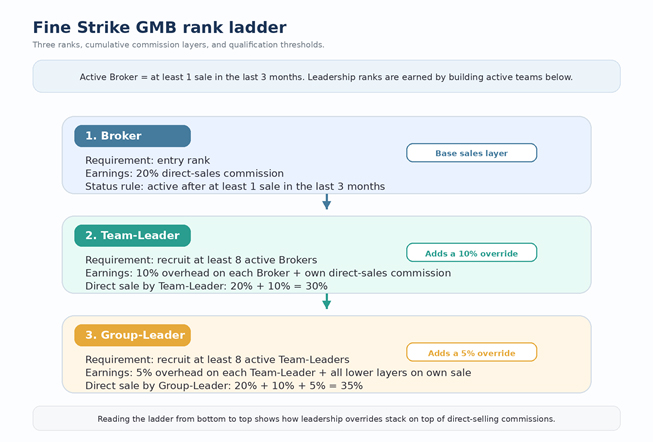
Figure 1 shows the structure as a ladder: every new leadership layer adds an override, but the lower layers do not disappear. They accumulate underneath the higher rank.
2. How commissions are paid on a sale
The plan states that commissions are cumulated downward. In practical terms, this means the rank making the sale keeps its own layer plus any layers below it. A Team-Leader who sells directly therefore earns the 20% direct-sales layer and the 10% Team-Leader layer, for a combined 30%. A Group-Leader who sells directly collects all three layers, for a total of 35%.
When a Broker closes the sale under a full three-rank structure, the payout is split 20% to the Broker, 10% to the Team-Leader, and 5% to the Group-Leader. That is why the total payout still equals 35%; the difference is the allocation across the hierarchy.
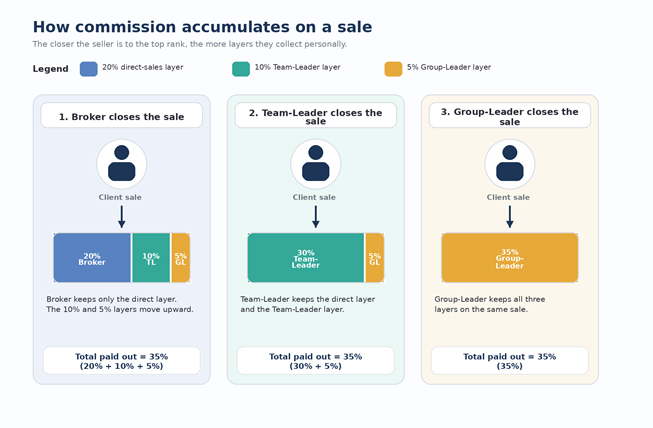
This design rewards personal selling at every level while preserving leadership income above the seller whenever the full hierarchy exists.
3. Promotion, equal rank, and the right of compensation
GMB does not only reward selling; it also rewards leadership development. A person becomes a Team-Leader by building 8 active Brokers, and a Team-Leader becomes a Group-Leader by building 8 active Team-Leaders. The plan then adds a safeguard for the sponsor when a recruit grows into the sponsor’s own rank.
The right of compensation is triggered when a recruit reaches the same level as the recruiter. At that moment, the recruiter loses the normal overhead on that recruit. To prevent the recruiter from being penalized for developing a leader, Fine Strike replaces the lost override with 10% of the recruit’s earnings, paid by Fine Strike rather than deducted from the recruit.
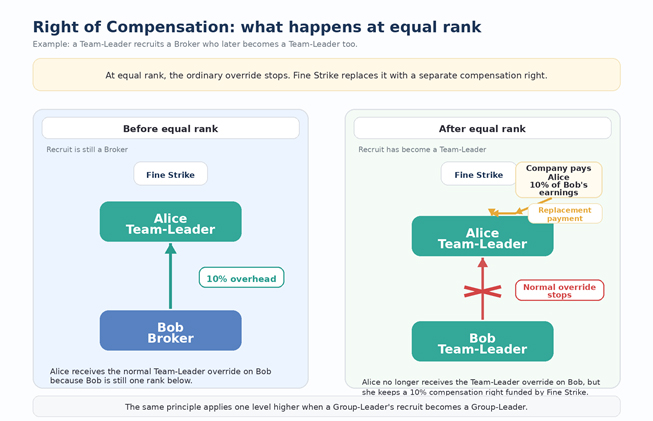
The logic is important: the recruit is allowed to stand on the same level as the recruiter, while the recruiter still keeps a company-funded economic link to the recruit’s success.
4. Rank maintenance and step-down rules
Leadership status is not permanent. A Team-Leader must continue to maintain at least 8 Brokers. If that minimum is not restored for more than one month, the Team-Leader becomes a Broker again. A Group-Leader must continue to maintain at least 8 Team-Leaders. If that minimum is not restored for more than two months, the Group-Leader becomes a Team-Leader again.
In both step-down cases, the person receives the right of compensation on recruits. In other words, the downgrade changes rank and override entitlement, but it does not erase the prior sponsoring relationship.
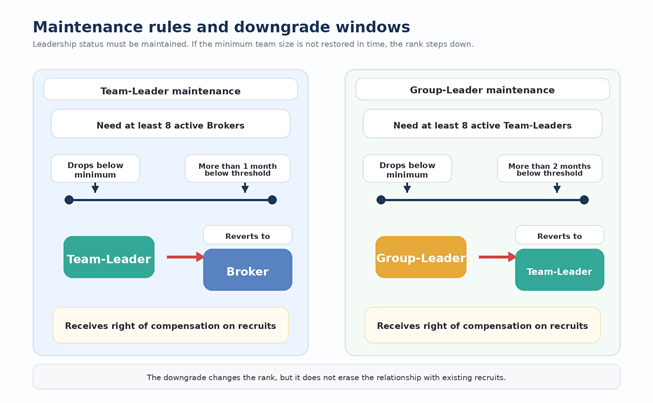
These maintenance rules keep leadership titles tied to current team performance instead of historic performance alone.
5. Worked examples
Using a sale price of 1,000 monetary units makes the commission logic concrete.
| Scenario | Payout on 1,000 units | Explanation |
|---|---|---|
| Broker sells | Broker 200 Team-Leader 100 Group-Leader 50 | The Broker keeps only the 20% direct layer, while the two leadership layers flow upward. |
| Team-Leader sells | Team-Leader 300 Group-Leader 50 | The Team-Leader keeps the 20% direct layer and the 10% Team-Leader layer, for a 30% combined payout. |
| Group-Leader salls | Group-Leader 350 | The Group-Leader sits at the top of the three-layer structure and therefore keeps all three layers. |
Leadership-development example: if Alice is a Team-Leader and Bob is her recruit, Alice earns the normal 10% Team-Leader overhead while Bob remains a Broker. When Bob becomes a Team-Leader too, Alice loses that ordinary overhead on Bob but receives a 10% right of compensation on Bob’s earnings at Fine Strike’s cost.
Conclusion
In essence, Fine Strike’s GMB rewards selling, recruiting, and developing leaders. The right of compensation keeps sponsors motivated to help recruits rise, and the maintenance rules keep leadership ranks tied to current performance. Together, these features make GMB a distribution system built on both retail activity and structured team growth.